
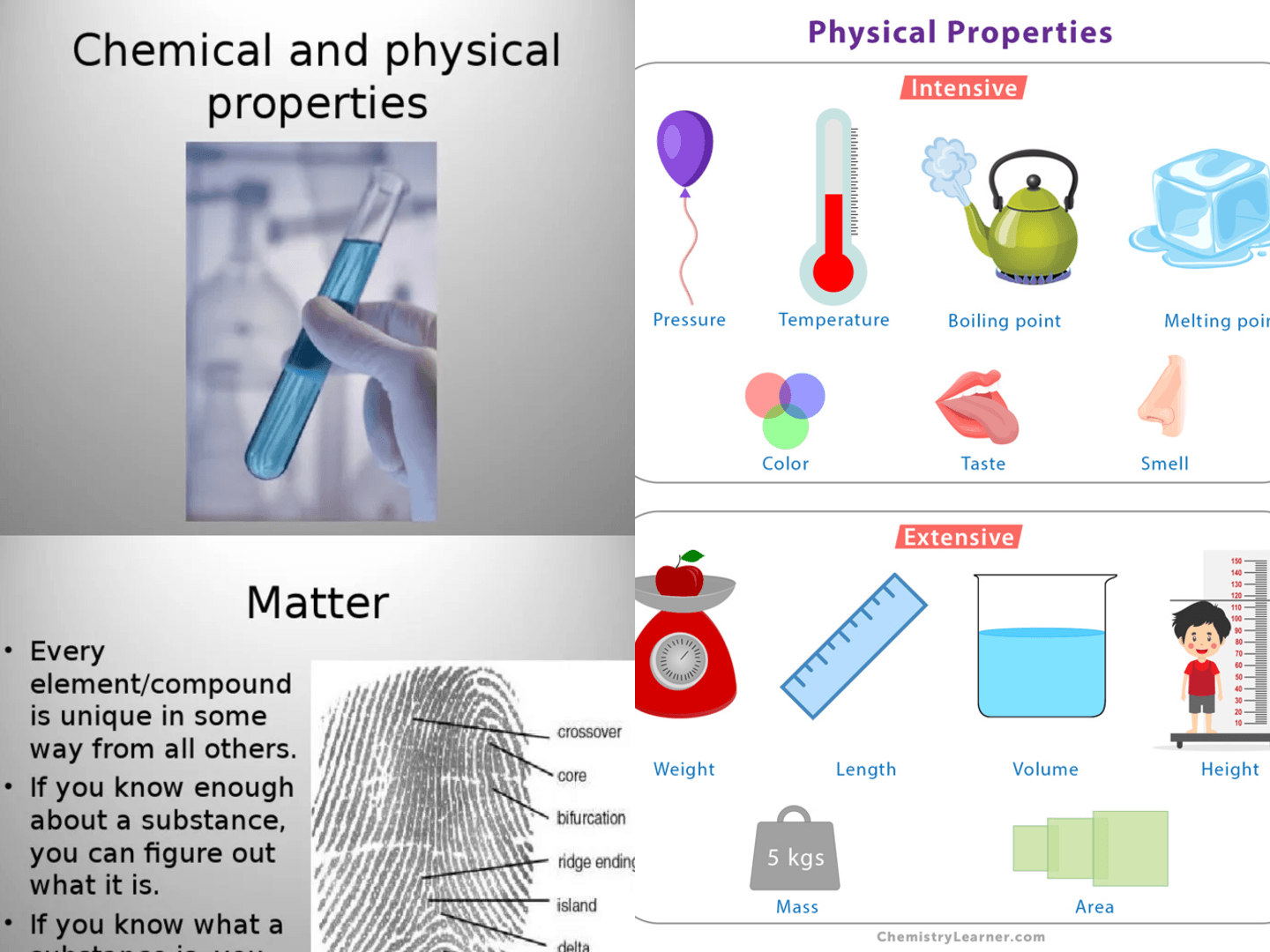
What are physical properties? They are characteristics of a substance that can be observed or measured without changing its chemical identity. In plain terms, you can look at them, touch them, or measure them, and the material stays exactly the same substance it was before you started .
That definition might sound dry, but it matters more than most people realize. Every time you check whether a pan is hot enough to sear a steak, test if a battery still has a charge, or notice that a diamond scratches glass while a fingernail does not, you are relying on physical properties . They are the practical, observable traits that help us describe, identify, and use the materials around us every day.
The key distinction is simple. A physical property can be observed or measured without altering the chemical composition of the sample . When you measure the melting point of ice, you watch it turn to water, but it is still H₂O. When you hammer gold into a thin leaf, the metal stays gold. No new substance appears .
Common physical properties include color, shape, density, hardness, melting point, boiling point, electrical conductivity, malleability, solubility, luster, and physical state . A copper penny, for instance, has a round shape, an orange-red color, a solid state, and a shiny luster . Gold offers another familiar example. The Royal Society of Chemistry lists its density at 19.3 grams per cubic centimeter and its melting point at 1064.18°C .
Chemists sort these traits into two groups based on whether the amount of material matters . Intensive properties stay the same no matter how much of the substance you have. Density, hardness, color, and boiling point are intensive . A small rock and a large rock of the same mineral have the same hardness and density, even though their sizes differ .
Extensive properties do depend on the amount of material present. Mass, volume, weight, and length are extensive . One paper towel weighs a certain amount; two paper towels weigh twice as much . Density is actually the ratio of two extensive properties, mass and volume, yet it functions as an intensive property because that ratio stays constant regardless of sample size .
Physical properties are often confused with chemical properties, but the difference is important. A physical property describes what a substance is like on its own. A chemical property describes how a substance behaves when it reacts and becomes something new . The ability of paper to burn is a chemical property because burning creates ash, gases, and heat, all different substances from the original paper .
Flammability, oxidation, rusting, and reactivity with acids are all chemical properties . Copper’s reddish-brown color is physical. Copper’s tendency to dissolve in nitric acid and form a blue solution is chemical . One you can see without changing the metal; the other changes it into new compounds entirely.Option 1: Quick Facts table about the concept itself
| Field | Information |
|---|---|
| Term | Physical properties |
| Field | Chemistry / Physical Science |
| Definition | Characteristics observable or measurable without changing a substance’s chemical identity |
| Key categories | Intensive and extensive properties |
| Common examples | Color, density, hardness, melting point, boiling point, conductivity, solubility, luster |
| Contrasted with | Chemical properties |
| Related concept | Physical change |
| States of matter | Solid, liquid, gas |
| Water reference points | Freezes at 0°C, boils at 100°C at normal pressure |
| Example element | Gold (density 19.3 g/cm³, melting point 1064.18°C) |
| Typical uses | Identifying substances, selecting materials, distinguishing pure substances from mixtures |
| Source basis | Standard chemistry references and textbooks |
Option 2: Tell me the actual subject
If “Physical Properties” was a placeholder and you meant a real person, a fictional character, a band, a YouTube channel, or something else, give me the name and I will build the 11 to 13 field Quick Bio table properly, using only verifiable information.
A physical change follows directly from physical properties. In a physical change, the state, shape, size, or appearance of a substance may shift, but its chemical composition remains the same . Ice melting into water, water boiling into steam, sugar dissolving in water, and gold being hammered into leaf are all physical changes .
Water is the classic example because it naturally exists in all three physical states. Ice is the solid form, liquid water is the familiar drinkable form, and steam is the gas . The particles arrange themselves differently in each state. In a solid, particles are tightly packed in a regular pattern and cannot move much. In a liquid, they are close together but can slide past one another. In a gas, they move quickly and stay far apart .
These arrangements produce the physical behaviors we rely on. Solids have a fixed shape and volume. Liquids have a fixed volume but take the shape of their container. Gases have neither a fixed shape nor a fixed volume and expand to fill whatever space holds them . Water freezes at 0°C and boils at 100°C at normal atmospheric pressure, which makes it a handy reference substance for temperature scales .
Physical properties matter because they are the primary way scientists identify and classify substances . A chemist who measures a liquid’s boiling point and density can narrow down what it might be. An engineer choosing a metal for electrical wiring needs to know its conductivity. A jeweler evaluating a gemstone relies on hardness and luster. The Royal Society of Chemistry notes that gold is the most malleable and ductile of all elements, which is why it can be beaten into translucent sheets thinner than a human hair .
Physical properties also help distinguish pure substances from mixtures. A pure substance has a consistent set of physical properties throughout. A mixture contains two or more substances that keep their individual identities . Salt water is a mixture because the salt and water can be separated by evaporation, restoring the original salt crystals . The physical properties of the salt and the water do not disappear just because they are combined.
Understanding physical properties is not just academic. It is the foundation for choosing materials, predicting how substances will behave under different conditions, and recognizing when a change is merely physical versus something deeper. If you can observe or measure it without creating a new substance, you are looking at a physical property.
Frequently Asked Questions About Physical Properties
What is the difference between a physical property and a chemical property?
A physical property can be observed or measured without changing the substance’s chemical identity. Color, density, and melting point are physical properties . A chemical property describes how a substance behaves during a chemical reaction, such as flammability or rusting. Copper’s reddish-brown color is physical; its reaction with nitric acid is chemical .
Is density an intensive or extensive property?
Density is an intensive property because it does not depend on the amount of substance present. A drop of water and a swimming pool of water have the same density of approximately 1 gram per milliliter . Mass and volume are extensive properties because they change with sample size. Density is calculated by dividing mass by volume, two extensive properties .
Can physical properties change without creating a new substance?
Yes. A physical change alters a substance’s state, shape, or size but leaves its chemical composition intact. Ice melting into water, sugar dissolving in coffee, and gold being hammered into thin sheets are all physical changes . Steam condensing into liquid water is another example, and the water remains H₂O throughout .
What are some everyday examples of physical properties?
Common physical properties include color, odor, density, hardness, melting point, boiling point, electrical conductivity, and solubility . The distinctive smell of gasoline, the lightness of helium compared to air, and the shine of silver are physical properties you encounter regularly . Hardness helps distinguish graphite in pencils from diamond, which is roughly seven times harder .
Why do scientists use physical properties to identify substances?
Every pure substance has a consistent set of physical properties that act like a fingerprint. Melting and boiling points are especially useful identifiers and can also reveal purity . A chemist who measures a liquid’s density and boiling point can narrow down its identity. Physical properties also help distinguish pure substances from mixtures .
