
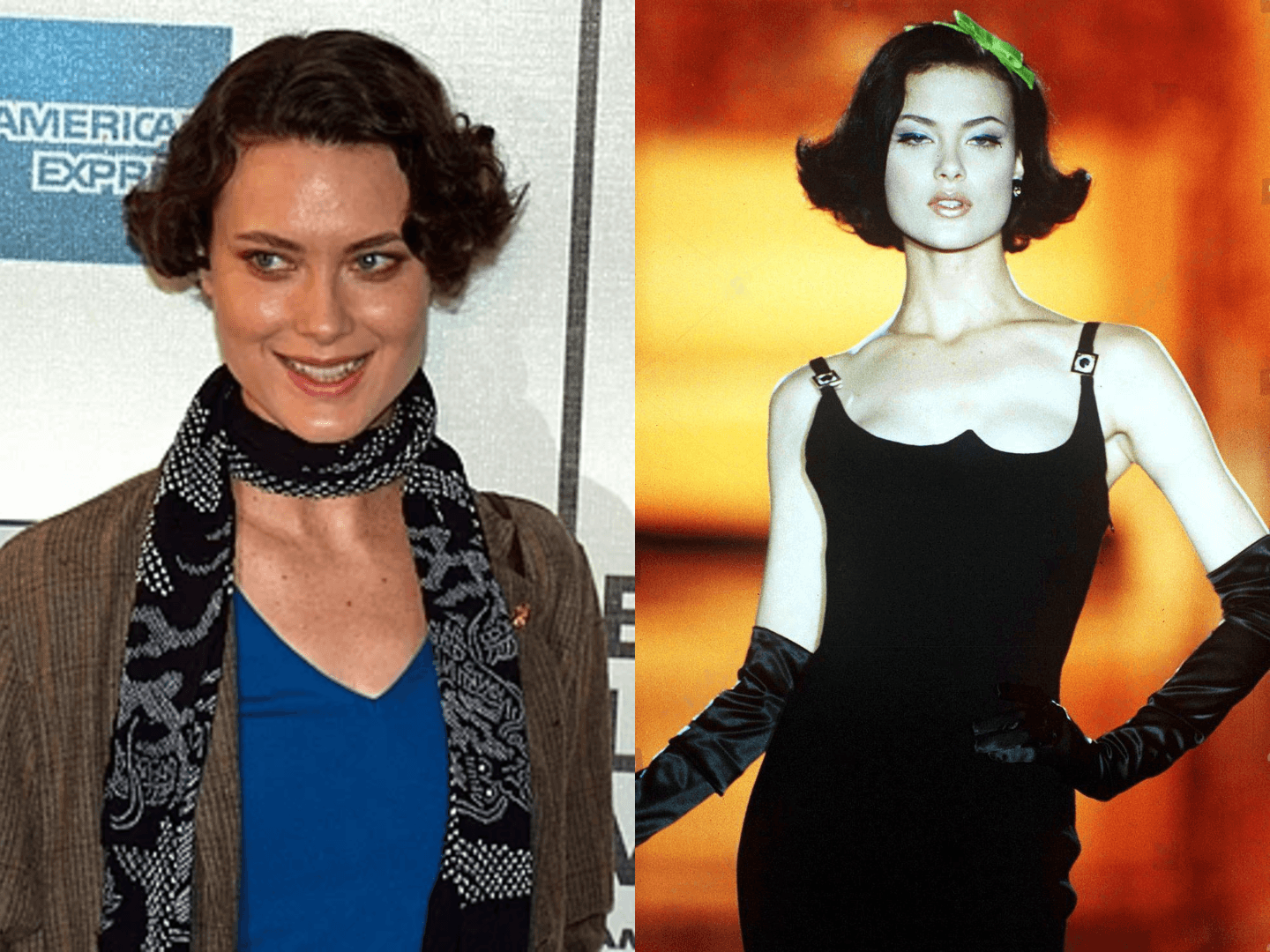
Shalom Harlow in the 90s was a runway performer whose ballet training and instinct produced fashion’s most enduring moments, from grunge’s anti-glamour to Alexander McQueen’s robotic paint-spraying spectacle. She was not a traditional supermodel but a live artist whose body and timing made designers’ concepts unforgettable.
Harlow was born in Oshawa, Ontario, and discovered at a Cure concert in Toronto. She had no relationship to fashion growing up and described entering the industry as arriving in Wonderland. Her background in ballet, however, would become her defining professional advantage.
Her earliest significant 90s appearance came at Marc Jacobs’s Spring 1993 grunge collection for Perry Ellis. Harlow walked alongside Kate Moss and Naomi Campbell in sneakers and layered knits. The collection drew from how Jacobs’s model friends actually dressed, and Harlow later said the clothes reflected her own off-duty style.
The viral moment arrived at Todd Oldham’s Spring 1995 show. Footage shows Harlow overtaking Amber Valletta on the catwalk, the two then turning and walking in unison . The clip has circulated for years and exploded again on TikTok, introducing Harlow to a new generation.
Contrary to tabloid framing, the moment was not a rivalry. Harlow told Vogue she was simply feeling the music and the crowd’s energy . Designer Todd Oldham confirmed the two were close friends, calling the perceived competition “funny” because “they love each other” .
The friendship extended beyond the runway. In 1996, Harlow and Valletta succeeded Cindy Crawford as co-hosts of MTV’s House of Style . MTV’s own archive described them as “huge nerds” whose chemistry made them relatable rather than remote. They also appeared together on the cover of Vogue USA in March 1997 .
Notes on Sourcing:
Education: This information comes from a children’s encyclopedia (Kiddle) and should be treated as unconfirmed until cross-referenced with a primary source .
Age and Birthplace: These are consistently reported across multiple sources, though IMDb and Wikipedia are the primary citations here .
Net Worth and Spouse: No authoritative financial disclosure or confirmed marriage record exists in the search results. The $10 million figure comes from an unreliable source . The Peter Sarsgaard mention is from a biographical database (NNDB) and is not confirmed by a major news outlet . The Hungarian Glamour article states she never married, but its reliability for factual biography is lower than established entertainment outlets .
The most historically significant moment came at Alexander McQueen’s Spring 1999 show, Collection No. 13. Harlow stood on a rotating wooden turntable in a white paper dress while two industrial robots sprayed her with black and neon yellow paint . The image became one of fashion’s most reproduced performances.
The performance worked because it was never rehearsed. Show producer Sam Gainsbury said Harlow “knew how to keep her center on the turntable because she was a dancer” and “didn’t flinch when they came near her face” . The inspiration came from artist Rebecca Horn’s installation of machine guns firing paint at each other .
Vogue later called the McQueen appearance “definitive, legendary, and haunting” . The contrast with a standard runway walk is instructive. Most models display clothing. Harlow, on that turntable, became part of the clothing’s destruction and transformation.
Her 90s portfolio also included a notable Dior moment. At John Galliano’s Fall 1997 haute couture show, Harlow wore a semi-nude mermaid-line gown in antique gold tulle with embroidered roses and chiffon leaf appliqués . The Daily Front Row described it as “one of the most gorgeous fashion moments of the ’90s” .
Harlow’s 90s career resists the usual supermodel narrative. She was not the highest-paid or most commercially visible. Her value lay in live performance and collaboration with designers who treated shows as theater. She was, in effect, a dancer who happened to wear couture.
The Todd Oldham clip and the McQueen robots continue to circulate because they capture something social media cannot manufacture. They show a model thinking and reacting in real time. Harlow’s ballet training gave her the control to make spontaneity look intentional.
Her legacy is best understood through that training. A dancer learns to hold center under pressure. Harlow held center on a rotating platform while machines sprayed paint at her face. That is not modeling. That is performance.
What is Shalom Harlow best known for in 1990s fashion?
Shalom Harlow is best known for Alexander McQueen’s Spring 1999 show, where she stood on a rotating platform in a white dress while two industrial robots sprayed it with paint. She is also remembered for the viral Todd Oldham Spring 1995 runway moment with Amber Valletta.
Was the Todd Oldham 1995 moment a real feud with Amber Valletta?
No. Harlow told Vogue she was simply feeling the music and the crowd’s energy. She overtook Valletta, then the two walked in unison and later emerged hand in hand, confirming their close friendship rather than a rivalry.
Why was Harlow chosen for the McQueen robot performance?
Harlow had ballet training, which allowed her to keep her center on the rotating turntable and stay composed as the robotic arms approached her face. Show producer Sam Gainsbury said the performance was completely spontaneous and could not be rehearsed.
Did Harlow and Valletta work together beyond the runway?
Yes. In 1996, they succeeded Cindy Crawford as co-hosts of MTV’s House of Style. Entertainment Weekly described them as acting like best friends rather than coddled fashion victims, and Karl Lagerfeld called them the Laurel and Hardy of beauty.
