
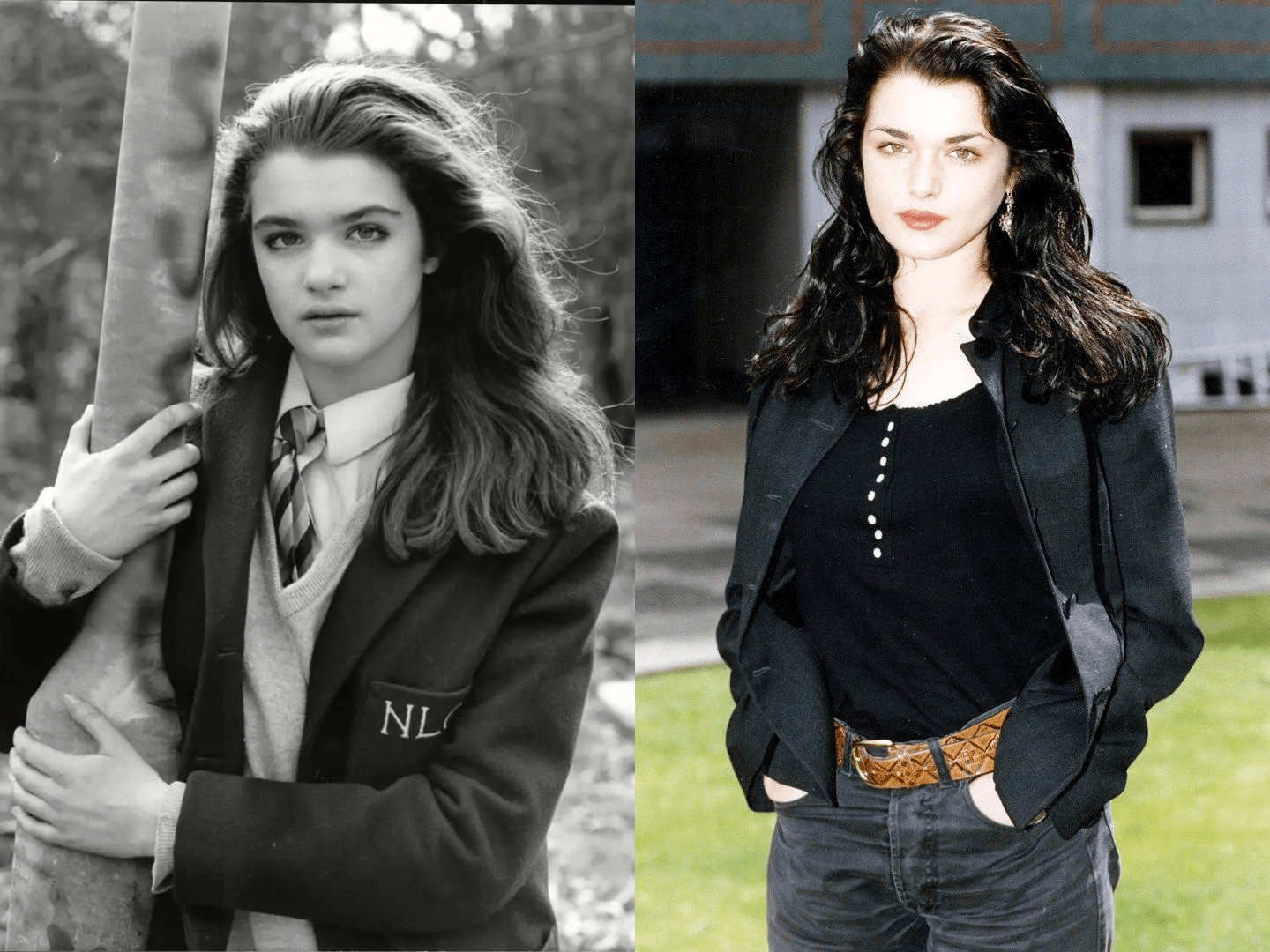
Rachel Weisz young was a London-born student who co-founded a theater company at Cambridge before breaking into film in her mid-twenties. Her path from university stages to Hollywood blockbusters followed a steady, deliberate arc rather than a sudden discovery. The documented record focuses on training, early stage awards, and breakthrough roles.
Rachel Weisz was born in London on 7 March 1970, according to IMDb, though the BFI Screenonline lists 1971 . Her father, George Weisz, was a Hungarian Jewish inventor, and her mother, Edith Ruth, was a psychoanalyst from Vienna . Both parents arrived in England around 1938 . She has one sister, Minnie, who became a curator and photographer .
Weisz studied English Literature at Trinity Hall, Cambridge University . During her time there, she helped form a student theater company called Talking Tongues . This decision marked her first serious commitment to performance beyond school productions. The company gave her practical experience in ensemble work and improvisation.
Talking Tongues achieved notable success at the Edinburgh Festival Fringe in 1991 . The company won a Guardian Student Drama Award for an improvised piece, which some sources identify as Slight Possession . Us Weekly reports the group was invited to the Fringe three times and also performed at the National Theatre . This early recognition signaled professional potential.
After Cambridge, Weisz moved into professional theater. She appeared in a revival of Noël Coward’s Design for Living, a production that earned her the London Critics’ Circle Theatre Award for Most Promising Newcomer. This stage credential established her credibility before film work began. The award specifically recognized emerging talent, placing her among a cohort of rising British performers.
Her screen debut came in 1995 with a small role as a junior executive in the horror film Death Machine . The following year brought a more visible part in Bernardo Bertolucci’s Stealing Beauty . The BFI describes her performance in that film as “witty,” noting it deflated much of the film’s pomposity . The role did not make her a star, but it introduced her to international art-house audiences.Quick Bio: Rachel Weisz
Note: Some sources report a birth year of 1971; this table uses 1970 as recorded by IMDb and the National Library of Israel . The net worth figure comes from third-party estimates and has not been officially confirmed by the actress.
The turning point arrived in 1999 with The Mummy, in which she played the librarian Evelyn Carnahan . The BFI credits her “superb performance” with combining romantic interest and substantial comic elements, calling it the key to much of the film’s charm . The film’s commercial success gave her widespread recognition. A BBC interview later noted that her “plucky, oh-so-English turn” in The Mummy made Hollywood take notice .
Comparing her early film work reveals a clear pattern. Stealing Beauty showcased her in an ensemble art film, while The Mummy placed her at the center of a mainstream studio production. The first demonstrated range; the second proved she could carry a blockbuster. This dual track, alternating between prestige projects and popular entertainment, became a defining feature of her career.
What the verified record does not support is detailed description of “young Rachel Weisz” photographs. The National Portrait Gallery holds portraits of her, but the available search results do not provide specifics about images from her youth. Claims about particular photographers or early portrait sessions should be treated cautiously unless confirmed by primary sources. The reliable information centers on her education, stage work, and film roles.
The outline of her early years is therefore clear. A London childhood in an artistic family led to Cambridge, where a student theater company became a launching pad. An Edinburgh award opened doors to professional stage work. A Critics’ Circle award confirmed her promise. Then came Stealing Beauty and, decisively, The Mummy. Each step built on the previous one, forming a coherent path from student performer to international actress.
What did Rachel Weisz study at university, and how did that shape her early career?
She studied English Literature at Trinity Hall, Cambridge. While there, she co-founded the student theater company Talking Tongues, which won a Guardian Student Drama Award at the 1991 Edinburgh Festival Fringe . This experience provided her first serious professional credential before film work began.
When did Rachel Weisz first gain major Hollywood attention?
Her breakout came with The Mummy in 1999, playing librarian Evelyn Carnahan. The BBC noted that her “plucky, oh-so-English turn” in the film made Hollywood take notice . Before that, she had appeared in Bernardo Bertolucci’s Stealing Beauty (1996), but The Mummy marked her transition to mainstream studio productions .
What was Rachel Weisz’s first major professional award?
She won the London Critics’ Circle Theatre Award for Most Promising Newcomer for her role in the 1994 revival of Noël Coward’s Design for Living . This stage award established her credibility as a serious performer before her film career accelerated.
Is there a confirmed record of “young Rachel Weisz” photographs?
Authoritative sources confirm that the National Portrait Gallery holds portraits of Weisz, but specific descriptions of photographs from her youth are not verifiable through reliable outlets. Claims about particular early portrait sessions should be treated cautiously unless confirmed by primary sources or official archives.
